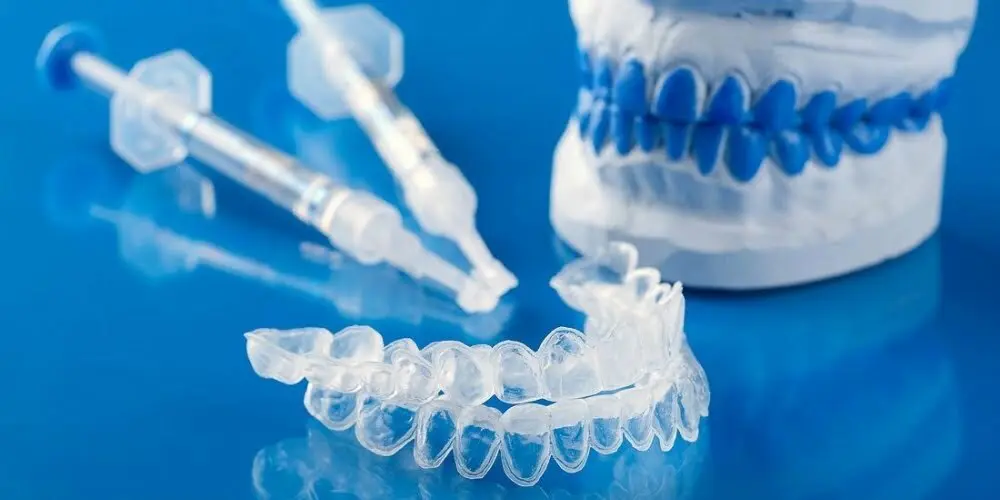
Kappa for whitening

A snow-white smile — the dream of many people. Tooth enamel changes color and turns yellow under the influence of various factors: bad habits, use of natural and artificial dyes in food and drinks, taking certain medications, etc. Whitening mouthguards are gaining more and more popularity recently. Therefore, it is worth considering whether they can make teeth white and beautiful and whether they can be an alternative to a professional procedure, which is quite expensive in dental clinics.

Types of whitening caps

A mouthpiece for teeth whitening is an overlay on the teeth made of thin and flexible plastic. The whitening cap serves as a reservoir for a special gel containing active components. Its composition includes hydrogen peroxide or carbamide peroxide (it has a milder effect on enamel), as well as fluoride or sodium nitrate to reduce sensitivity. It is these substances that provide the whitening effect. Depending on the method of manufacture and structural features, whitening mouthguards are of the following types: 

  • Standard. They are made according to standard sizes without taking into account the features of the jaw structure and the location of the teeth of a particular person. Teeth whitening with mouthguards of a standard type is not suitable for everyone. The design may not be suitable due to the size or features of the patient’s jaw structure. Such structures are inexpensive, but have one significant drawback – they often do not fit tightly to the teeth, so there is a high risk of gel leakage, which leads to irritation and burns of the mucous membrane.
  • Thermoplastic. These whitening mouthpieces are also made in standard sizes, but differ in that they are made of a special material that changes its shape when the temperature changes. Before use, the structure must be heated in hot water, as a result, it fits tightly to the teeth. When using this option, there is less risk of the gel getting on the mucous membrane, although there may be difficulties with an incorrect bite.
  • Individual. This is the most expensive, but the most safe and effective option. Such teeth whitening mouthguards are distinguished by the fact that they are made for a specific person based on individual casts of the jaw. They always fit tightly to the teeth, so there is no risk of burns when used correctly. Disadvantages include the need to visit the doctor several times and the high cost of overlays.

What effect can be achieved when using caps?

Professional dentists claim that teeth whitening with a mouth guard cannot radically change a smile for the better. It is usually possible to lighten the enamel color by 2-4 tones. If a more pronounced result is needed, it is wiser to do a professional procedure right away. The effectiveness of home whitening depends on a number of factors: 

  • proper training;
  • strict adherence to all oral care recommendations;
  • the right menu and other factors.

It will not be possible to achieve the desired results if you do not give up bad habits or continue to use coffee, tea or other drinks, products that can stain tooth enamel. If you do not cure caries and carry out teeth whitening, the mouthguard will also be ineffective, as in the case of a change in color as a result of pathological processes and hereditary predisposition.Many people use teeth whitening mouthguards, and the reviews often vary greatly. It depends on the person’s expectations, existing problems and other factors. Both doctors and patients confirm that a teeth whitening cap can be effective in maintaining a long-lasting effect after a professional procedure.

What are the pros and cons of whitening caps?

Teeth whitening with mouth guard has a number of advantages: 

  1. The procedure is performed at home, there is no need to go to the dentist.
  2. You can whiten your teeth with mouthguards at a convenient time, anywhere.
  3. The first results will become noticeable in a couple of days, provided that all the doctor’s recommendations are followed.
  4. Teeth whitening mouthguards are usually transparent and invisible to the naked eye.
  5. The design is inexpensive (with the exception of individual designs).

 Teeth whitening with a mouth guard is not without disadvantages:

  • long-term use – the mouthguard must be worn for several weeks or months;
  • absence of the expected effect in some cases;
  • possible speech defects.

A whitening cap can cause mucosal irritation if improperly fitted or improperly used.

How to use a mouthpiece for teeth whitening: simple recommendations

It is important to know how to use a mouthpiece for teeth whitening so that its use is effective and safe. Follow these recommendations: 

  • Brush your teeth with regular toothpaste.
  • Take out the mouthguard, put the required amount of gel in it.
  • Place the aligners on your teeth so that they fit snugly. The gel should not touch the gums. If the gel comes out, remove it with a tissue.
  • Wear for 30 minutes to 8 hours.
  • After removing the pads, thoroughly rinse the remaining gel with water, and rinse and dry the cap.
  • The mouthpiece for teeth whitening should be stored in a special ventilated case.

If burning, pain or other unpleasant symptoms occur during the procedure, stop bleaching. Rinse your mouth well with water to wash away any remaining gel.

Polityka prywatności i plików cookies  •  Prawa Pacjenta – NOWA Sp. z o.o.  •  Informacja o zbieraniu danych osobowych  •  Standardy Ochrony Małoletnich